Friday, October 3, 2014

Newton Lower Falls Branch: Route of the "Ping Pong"

A new section of the Charles River path system opened recently, a rail-to-trail walkway following the route of what was once the Boston & Worcester Railroad's Newton Lower Falls Branch. This very short branch, a mere 1.2 miles long, branched off from the mainline at Riverside Station.  The river in Riverside is the Charles River, which meanders in all directions while forming the boundary between Newton and Wellesley, Massachusetts.

The Newton Lower Falls Branch followed the east bank of the Charles River,
only a bit over a mile east of the Boston & Worcester Main Line
The rail lines in Massachusetts tending to branch out to serve the mills.  And the mills would locate themselves along the rivers, particularly at waterfalls, where the power of the falling water could be harnessed.

So, it proved economically worthwhile to construct this diminutive branchline along the east bank of the Charles, and curving to a river crossing and entering into a village simply called Lower Falls.

The Charles River, as seen from the
rail bridge near Lower Falls
While the freight service was unremarkable in itself, what made this branch special was its passenger service.  In 1867, the Boston & Worcester merged with two other lines to become the Boston & Albany, spanning the state and connecting to the mighty New York Central and Hudson River Railroad, which stretched west to Chicago.  While trains running overnight between Boston and Chicago ran on the mainline, the Lower Falls branch had a mere shuttle service, connecting Riverside Station on the mainline with the branch's namesake village.

Electric car #01, the "Ping Pong"
(Collection of Norman D. Clark)
With the advent of electric power came the widespread use of electric trolley cars and interurbans in the late 1880s and 1890s.  This inspired the Boston & Albany to eliminate the clumsy use of a locomotive and passenger cars to travel so short a distance.  In 1900 they converted a passenger car into their own version of an interurban, and gave it the number "01."

Since all it did, day in and day out, was shuttle back and forth this little 1.2-mile trip, it was nicknamed the "Ping Pong."

(Collection of Roy Lannigan)
In 1930, the "Ping Pong" was retired, and a single locomotive and passenger car.  Eventually, passenger service ended in 1957.  Freight service continued for a couple of decades.  

Now with rail service a distant memory, the one section of the line, between Washington Street in Wellesley and Concord Street in Newton, had become a walking path.  A wood deck bridge sets on the steel of the rail bridge over the Charles.

In Wellesley, the path transitions from concrete to stone dust as one approaches the Charles.

The path crosses the Charles River reusing the rail bridge.
The wood deck and railings of the footbridge.
Approaching the bridge from the Newton side.
Looking north across Concord Street:  the rails still remain, overgrown.
References:
Humphrey, Thomas J. and Clark, Norman D, "Boston's Commuter Rail: Section Section," Boston Street Railway Association, Inc., 1986.
Karr, Ronald Dale, "The Rail Lines of Southern New England: A Handbook of Railroad History," Branch Line Press, 1994.


Except as noted, all photographs by Rachel Burckardt, Sept. 27, 2014.

Sunday, August 10, 2014

View from a Deck in East Boston

Tourists typically see Boston Harbor from the view on the Boston  side, from Rowe's Wharf or Long Wharf, or Lewis Wharf.  Residents of "Eastie" (as many call East Boston) know they have some of the best views of the harbor.  At the right, a sailboat passes into view.

The following photos show the array of from just one of the many decks that afford residents of Eastie with great views of Boston Harbor.
View to the Boston Hyatt Hotel at Logan Airport.  The airport administration building is just to the left of the hotel.
In the foreground is part of a working shipyard on the harbor waterfront. 
Sunset and the Boston Skyline as seen from across the harbor in East Boston.

Friday, July 11, 2014

A Favorite Room

My son #2 has always been fascinated with this house in the neighborhood, particularly the two-story glass sitting room.  

Imagine walking from a regular living room into this space that suddenly opens up vertically and is flooded with daylight on 3 sides.  Imagine it at night as a glass-encased box of warm light, visible to all who walk by.

Just another example of interesting architecture visible to those who stroll the streets of our fair city.

Sunday, June 15, 2014

Around Town

Swan boats in the lagoon at Boston's
Public Garden
The spring is a time when, even in the city and the urban environs, we can see the subtle changes of the season.  This makes me more observant of the little details all around, as I walk around, to and from work, or going about the chores, or out on a bike ride.  Once in a while, I'm lucky to capture just some snippets of the visual feast all around.  This post is just a sample of them.

A view through the graceful drapings of the willows on the banks of the
lagoon at the Public Garden, just steps from my office.
 

I just love this collection of flowers in a garden near my home in Cambridge.

My favorite footbridge is constructed with steel arches and cables
 supporting the wood deck.  This is the Blue Heron Bridge over the
Charles River between Newton (foreground) and Watertown, on a June
Sunday as I was biking the river paths out to Waltham.

I loved the lighting of early evening as the somber crowd leaves Fenway Park.
The "green monster" seats hang over Landsdowne Street.  Sox lost 3-2 to Cleveland.
Sunset over the Charles, framed by the Boston University Bridge.

Saturday, March 29, 2014

The Hope of Spring


This has been a particularly brutal winter.  Not so much was it the greater than normal snowfall, but the bitter, bitter cold that numbed the hands, even with gloves on.  It was both discouraging and certainly depressing.

So, with March comes the mini-season of "Hope of Spring."  Sometimes we see something budding, such as the first signs of our jonquils budding in the front planter, which gets the afternoon sun.

The first hope for spring in the garden:  the jonquils are budding!
Later on a walk to Harvard Square to get a few gifts for the little girl I babysit (Naomi), I ran into a couple staring at the snow drops emerging from the dirt and leaf litter, just off the brick sidewalk.

Left:  tiny snow drops emerge from the cold ground on a sunny March afternoon.
Right:  crocuses emerge from the leaf litter in a Cambridge garden.
It's March and the March flowers (jonquils) are slowly reaching up for the sunshine.
Almost there:  the jonquils just need one warm sunny day to convince them to open their yellow flower and smile as the sun.  Yes, the Hope of Spring has come!

Sunday, December 22, 2013

Winter Evening

December brings short days and chilled evenings.  But what compensates for shivering outside and inside alike (our place is not so well-insulated) is the soft yellow lighting of the later afternoons, as well as the Christmas card dusk light of snow-covered scenes, such as the one on the right in Brookline, just outside of Boston.

The visual treats make the winter evenings of December a special time of the year.


Late afternoon waterscape.   The Charles River near Watertown Square.

A few weeks later, the Charles River is frozen and snow-covered, as seen through the wood near the river bank.

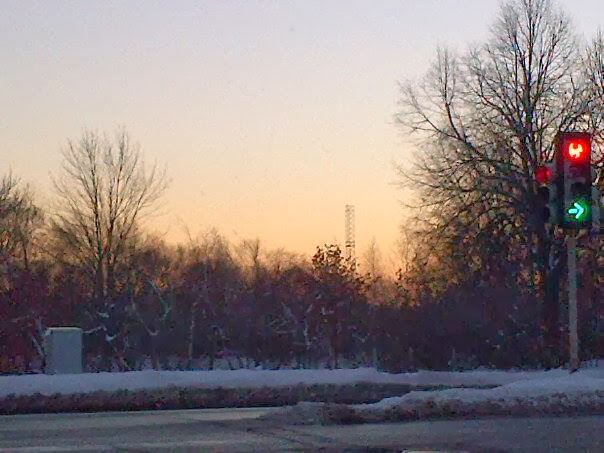
Slightly pinkist hue of the early dusk on a snow-covered December evening along the Fresh Pond Parkway in Cambridge.

Dusk sky above a snowy scene in Cambridge

Even the stop lights show red and green for the coming Christmas season.
For examples of the warm yellow lighting of late winter afternoons, see my post "Beauty in Urban Industrial Photography."

Saturday, October 26, 2013

Views of a Muted Autumn

Perhaps it's been a bit dry, or it was too wet, or the temperatures too warm.  I'm not sure, but the colors have been fairly muted this fall.  

Often we witness truly brilliant colors.  We have the bright oranges and reds of the sugar maples, the brilliant yellows of the honey locusts, birch and flowering pears.  Each tree's timing is a little different, creating a magnificent backdrop of color. 

In past years, the colors were simply more brilliant.  Here are some examples from my blog posts:  Boston's Public Garden in 2009,  Mt. Auburn Cemetery, also in 2009, or this slideshow of fall views around my fair city of Cambridge.

In contrast, here's a few views of fall 2013 in Boston and vicinity.


Early in the season, muted red browns along the Charles River

Some colors mix with greens and bare branches along a busy street in Cambridge.
Going way out to the 'burbs, one can find colorful stands of trees, like these in Methuen.

Nice work by the architect to coordinate the exterior color with the fall hues of the street trees.
Returning to the 'burbs, brilliant oranges of the maples mix with the greens and yellows in Wellesley.
Stand of paper birch near a playground in Cambridge.